
Commercial Exterior Aluminum Doors are engineered entry systems designed for demanding business environments. They commonly serve offices, retail stores, schools, hospitals, and industrial facilities. Their frames usually combine aluminum profiles, glass panels, weather seals, hinges, closers, and commercial-grade locking hardware. Aluminum offers a useful balance of low weight, corrosion resistance, and design flexibility. It also supports wide entrances and frequent daily operation.
Details matter. A well-specified door should match the building’s traffic level, exposure, security needs, and accessibility requirements. Installers often examine threshold drainage, frame anchoring, glass safety ratings, and hardware durability before fitting the assembly. Manufacturer documentation can clarify air infiltration, water resistance, thermal performance, and cycle testing. These details help buyers compare products responsibly, rather than choosing by appearance alone. A bright anodized finish may look impressive under showroom lights, but field conditions can reveal poor sealing or weak installation.
They are not indestructible. Aluminum can conduct heat, hardware can loosen, and incorrect adjustment may cause uneven closing. Even a premium door may perform poorly when the surrounding wall is not prepared correctly. That assumption is easy to miss. Professional measurement, careful installation, and scheduled inspection usually protect long-term performance. Building owners should also confirm local project requirements with qualified architects, contractors, or code professionals. In practical terms, the best Commercial Exterior Aluminum Doors are not simply attractive entrances. They are coordinated systems, selected for real traffic, weather, maintenance routines, and user safety. Performance depends on every part working together.
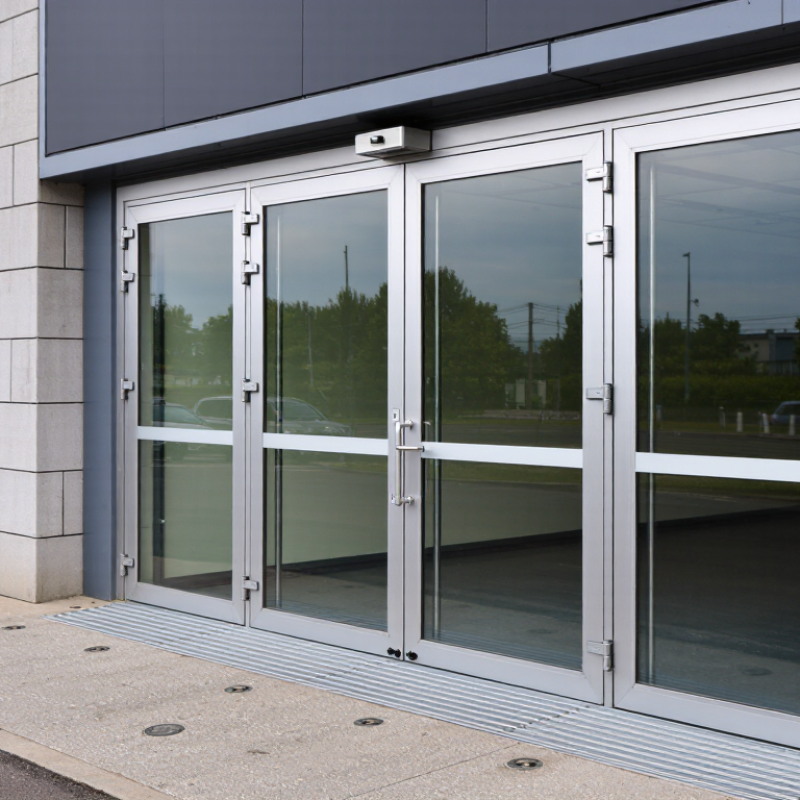
What Is a Commercial Exterior Aluminum Door?
A commercial exterior aluminum door is an entrance system designed for frequent use and outdoor exposure. It commonly serves offices, retail spaces, schools, clinics, and industrial buildings. Unlike residential doors, it must handle heavier traffic, stronger weather, and stricter performance demands.
Aluminum frames provide a practical balance of low weight, strength, and corrosion resistance. They do not rust like ordinary steel, although surface damage can still cause problems. Most systems include insulated glass, weather seals, reinforced hinges, and durable locking hardware. These features help control drafts, rain, noise, and unauthorized entry. Thermal breaks may also reduce heat transfer through the frame. That matters in heated or cooled buildings.
The door’s performance depends on more than its material. Frame alignment, threshold height, drainage paths, and installation quality all affect daily operation. A poorly adjusted door may scrape the floor or leave a visible gap after several months. Small gaps matter. From field experience, maintenance teams often notice hardware wear before frame damage. Regular inspection can reveal loose fasteners, compressed seals, or water marks near the threshold. No door is maintenance-free. Designers should also consider opening size, traffic volume, accessibility, and local building requirements. Aluminum remains a strong choice, but only when its specification matches the building’s real conditions.
| Data Dimension | Typical Data or Definition | Practical Significance |
|---|---|---|
| Definition | A commercial exterior aluminum door is an entrance or service door made primarily from aluminum framing and designed for use on the outside of commercial buildings. | It provides controlled access, weather separation, security, and pedestrian traffic management at offices, retail facilities, schools, healthcare buildings, and other non-residential properties. |
| Primary Frame Material | Aluminum alloy, commonly selected for its low density, corrosion resistance, and ease of fabrication. | Aluminum is substantially lighter than steel while offering adequate structural performance for many commercial door applications. Alloy and temper should be selected according to the project design. |
| Common Door Types | Single swing, pair of swing doors, narrow-stile doors, medium-stile doors, storefront doors, automatic sliding doors, and automatic swing doors. | The configuration is chosen according to opening width, traffic volume, accessibility needs, security requirements, and available circulation space. |
| Typical Door Leaf Thickness | Approximately 38–45 mm for many commercial aluminum entrance doors; actual dimensions depend on the system and performance specification. | Thickness affects stiffness, hardware compatibility, glazing options, thermal performance, and resistance to repeated use. |
| Typical Door Height | Approximately 2,000–2,400 mm for common commercial pedestrian entrances, subject to local accessibility and building requirements. | The finished opening must be coordinated with clear headroom, door closers, panic hardware, glazing, and the surrounding storefront system. |
| Typical Single-Door Width | Approximately 800–1,000 mm overall leaf width is common; the required clear opening is determined by applicable accessibility rules. | Clear opening, rather than nominal leaf size, is the key measurement for wheelchair access, deliveries, and emergency egress. |
| Glazing Options | Single safety glass, laminated safety glass, insulated glass units, or opaque aluminum panels. | Glazing can provide visibility and daylight, while laminated or insulated configurations can improve safety, sound control, and energy performance. |
| Thermal Break | A thermally improved frame uses a low-conductivity separator between interior and exterior aluminum sections; non-thermal frames do not. | Thermal breaks reduce heat transfer and the risk of interior condensation, making them useful in conditioned buildings and varied climates. |
| Weather Resistance | Weather performance depends on perimeter seals, thresholds, drainage paths, glazing seals, installation, and tested air and water resistance. | Exterior doors should be selected and installed according to the building exposure, wind conditions, rainfall, and applicable test requirements. |
| Hardware | Common hardware includes hinges, locks, cylinders, lever handles, pull handles, door closers, thresholds, exit devices, and access-control components. | Hardware must match the door weight, traffic frequency, security level, accessibility requirements, and emergency-exit strategy. |
| Security Features | Security options include multi-point locking, reinforced lock areas, laminated glazing, access-control readers, electric strikes, and monitored door contacts. | The security package should reflect the building’s occupancy, threat level, operating schedule, and requirements for authorized entry. |
| Accessibility | Accessible entrances generally require an adequate clear opening, manageable opening force, suitable hardware, maneuvering clearance, and compliant thresholds. | Exact requirements vary by jurisdiction and project type, so the door assembly should be reviewed against the applicable accessibility code before fabrication. |
| Surface Finishes | Typical finishes include anodized aluminum and factory-applied powder coating in a range of colors and gloss levels. | The finish influences appearance, color consistency, scratch visibility, ultraviolet exposure performance, and routine maintenance needs. |
| Durability | Designed for repeated daily operation, with performance determined by frame design, door weight, hardware grade, installation quality, and maintenance. | High-traffic entrances require heavy-duty components and scheduled inspection of hinges, closers, seals, fasteners, and locking hardware. |
| Fire and Egress Considerations | Not every aluminum entrance door is fire-rated. Fire-rated or emergency-exit applications require a tested and code-compliant door, frame, glazing, and hardware assembly. | The complete opening assembly must satisfy local fire, life-safety, exit, and occupancy requirements where applicable. |
| Maintenance Requirements | Routine care includes cleaning, checking fasteners and seals, lubricating or adjusting hardware where permitted, and inspecting drainage and thresholds. | Regular maintenance helps preserve operation, weather resistance, security, and service life, particularly in coastal, wet, dusty, or high-traffic environments. |
Note: Dimensions and performance values are typical planning ranges, not universal specifications. Final selection should be based on the project drawings, local building and accessibility codes, site exposure, and tested product data.
It is an entrance system built for frequent use and outdoor exposure. It may include aluminum frames, glass, seals, hinges, closers, and locks. It serves offices, schools, clinics, shops, and industrial buildings. It is not maintenance-free.
Aluminum is lightweight, strong, and resistant to ordinary rust. It supports wide openings without bulky framing. It also suits humid areas and busy streets. However, damaged finishes may still create corrosion problems.
Common options include single doors, double doors, sliding doors, folding doors, and pivot doors. Single doors suit smaller openings. Double doors support heavier traffic and wider deliveries. Sliding doors help when swing space is limited.
Thermal breaks reduce heat transfer through the frame. Insulated glass can limit indoor heat loss. Low-emissivity glazing may reduce unwanted solar heat. Continuous seals help control drafts and wind-driven rain. Small gaps still matter.
Weather seals, raised thresholds, proper drainage, and accurate installation work together. Drainage paths should move rain away from the entrance. A blocked threshold may hold water after a storm. That detail is easy to overlook.
Consider opening size, traffic volume, wind exposure, accessibility, security, and cleaning needs. Match hinges and closers to the door’s weight. Check evacuation requirements and local building rules. One design cannot suit every entrance.
Misalignment may make the door scrape the floor. Loose fasteners can create movement and noise. Compressed seals may leave visible gaps. An undersized threshold may allow water inside. Attractive design cannot repair poor installation.
Inspect seals, hinges, locks, closers, fasteners, and drainage paths regularly. Test automatic sensors and operators when installed. Look for water marks near the threshold. Maintenance teams often find hardware wear before frame damage.
Check alignment, seal compression, drainage, operating force, and closing speed. Test the door during realistic daily use. Review air, water, structural, and thermal requirements. The process may still miss small seasonal problems.
Commercial Exterior Aluminum Doors are entrance systems designed for the outside of commercial buildings, combining a lightweight aluminum frame with durable panels, glass, hardware, and weather-resistant finishes. They are commonly available as storefront doors, entrance doors, narrow-stile or medium-stile systems, sliding doors, and thermally improved configurations. Their construction may include reinforced frames, insulated glass, reliable hinges or rollers, secure locks, weather seals, and finishes selected to withstand frequent use and changing outdoor conditions.
These doors offer corrosion resistance, low maintenance, design flexibility, and dependable performance in offices, retail spaces, schools, healthcare facilities, hospitality properties, and industrial buildings. Choosing the right system requires considering traffic volume, opening size, energy efficiency, security, accessibility, local building requirements, and compatibility with the surrounding façade. Proper measurement and professional installation help ensure smooth operation and weather protection, while routine cleaning, hardware inspection, seal replacement, and finish maintenance can extend service life and preserve appearance.