
Explore our premier range of structural aluminum casement glazing systems, custom geometric wall panels, and dynamic facade architectural components engineered for modern building envelopes.
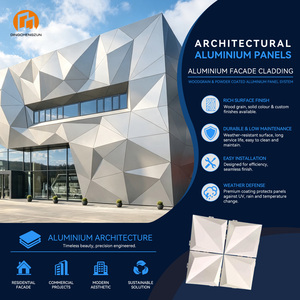
Engineered for high-rise architectural accent walls, offering superior wind-load resistance and geometric spatial aesthetics.
Send an Inquiry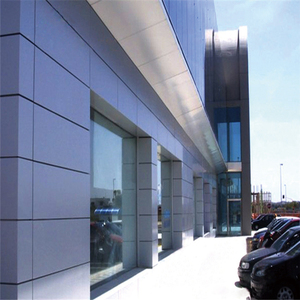
High-rigidity composite paneling with fluoropolymer PVDF coating for maximum weatherability and thermal isolation.
Send an Inquiry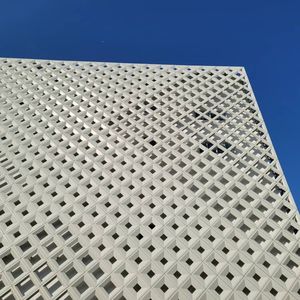
Precision CNC laser-perforated structural screens providing passive shading, structural ventilation, and acoustic mitigation.
Send an Inquiry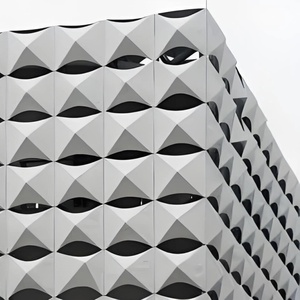
Class A fire-rated structural alloy cladding, designed for seamless integration with commercial storefronts and window assemblies.
Send an Inquiry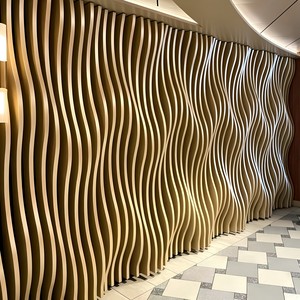
Hyper-durable heat-transfer wood grain finish applied to curved aluminum extrusion profiles for biophilic design integration.
Send an Inquiry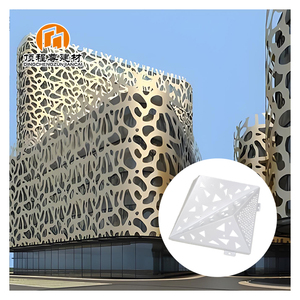
Architectural envelope panels optimized for mid-rise hotel and commercial window perimeter structural framing.
Send an Inquiry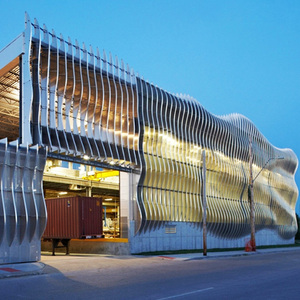
Next-generation dynamic kinetic cladding systems engineered to mitigate solar heat gain and micro-vibration loads.
Send an Inquiry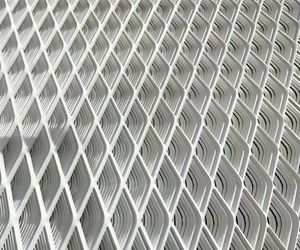
High-tensile expanded aluminum mesh profiles optimized for building envelope airflow, acoustic attenuation, and modern solar control.
Send an InquiryAn authoritative analysis of structural aluminum alloy processing, thermal breaking physics, advanced glazing configurations, and global compliance standards for enterprise specifiers.
China’s leading casement window factories utilize high-grade 6063-T5 and 6063-T6 architectural aluminum alloys. These extrusions undergo precise artificial aging processes to achieve ultimate tensile strengths exceeding 205 MPa and yield strengths up to 170 MPa.
With wall thicknesses strictly complying with GB/T 8814 and ASTM B221 (minimum 1.4mm to 2.0mm structural wall profiles for residential and heavy commercial windows), these systems guarantee structural deflection limits under severe wind pressures (up to 5000 Pa).
Thermal bridging is virtually eradicated through high-precision insertion of PA66 GF25 (25% Glass-Fiber Reinforced Polyamide) thermal barrier strips. Unlike inferior PVC insulations, PA66 GF25 matches the linear thermal expansion coefficient of aluminum ($2.3 \times 10^{-5}/K$).
This ensures zero structural shearing or sealant failure under extreme thermal cycling ($-40^\circ\text{C}$ to $+80^\circ\text{C}$), achieving frame thermal conductance values ($U_f$) as low as $1.3\text{ W/m}^2\text{K}$.
Standard high-performance configurations feature insulated glass units (IGUs) with double soft-coat Low-E glass, 90% Argon gas fill, and Technoform warm-edge spacers.
By incorporating asymmetric double or triple glazing combinations paired with acoustic PVB interlayers (e.g., 6mm Low-E + 16Ar + 4mm + 1.52PVB + 4mm), Sound Transmission Class (STC ratings up to 45 dB) and Outdoor-Indoor Transmission Class (OITC 38) are routinely accomplished.
The global building envelope market is experiencing a paradigm shift driven by stringent decarbonization targets, updated building codes (such as Canada's Step Code and European Passive House Standards), and smart building integration. China’s premier casement window manufacturers are leading this evolution through key engineering innovations:
Modern architectural aesthetics demand maximized daylighting ratios. Modern casement systems utilize concealed hinges, ultra-narrow frame profiles (less than 45mm visible width), and flush sash designs where the sash seamlessly aligns with the outer frame. This design enhancement boosts light transmittance by up to 18% while maintaining structural integrity.
Casement windows are increasingly integrated into building management systems (BMS). Embedded linear actuators, combined with automated rain and wind sensors, allow programmed micro-ventilation cycles. Multi-point motorized locking systems provide RC2/RC3 burglar resistance without compromising human-centric automation.
The next frontier in thermal performance involves substituting traditional double/triple IGUs with Vacuum Insulated Glass (VIG). Achieving U-factors below $0.60\text{ W/m}^2\text{K}$ ($U \le 0.10\text{ BTU/h}\cdot\text{ft}^2\cdot^\circ\text{F}$) in a slim 8.3mm profile, coupled with semi-transparent Building Integrated Photovoltaics (BIPV) spandrels, shifts casement windows from energy consumers to active solar energy harvesters.
Air leakage and water ingress under storm conditions are eliminated using continuously vulcanized EPDM foam gaskets. Utilizing automotive-grade co-extrusion technology at frame corners, these seals resist thermal degradation and UV radiation, ensuring air infiltration performance under ASTM E283 of < 0.01 L/s·m².
Procuring custom commercial casement windows directly from top-tier Chinese manufacturers has evolved beyond simple unit-cost arbitrage. Modern enterprise procurement strategies focus on value-engineering, single-source vertical integration, and environmental supply chain transparency.
Leading Chinese suppliers handle profile extrusion, anodizing/PVDF coating, glass tempering, thermal break strip insertion, unit assembly, and factory glazing under one roof. This minimizes quality hand-off risks and reduces production lead times by up to 35%.
Advanced engineering teams utilize Revit and AutoCAD software to generate 3D BIM models and parametric shop drawings prior to extrusion cutting. This eliminates field-clash issues, ensuring exact fitments for structural openings.
Top-tier suppliers provide third-party verified Environmental Product Declarations (EPDs) and low carbon footprint aluminum billets (recycled/hydro-powered aluminum), supporting projects striving for LEED v4.1 and BREEAM certifications.
The following technical data matrix illustrates performance benchmarks across various casement and window configurations manufactured to global standards (CSA A440 / AAMA-NAFS / EN 14351-1):
| System Configuration | Overall U-Factor (W/m²K) | Air Infiltration (ASTM E283) | Water Resistance (ASTM E331) | Structural Load (ASTM E330) | Acoustic Rating (STC / OITC) |
|---|---|---|---|---|---|
| 60mm Non-Thermal Aluminum Casement | 3.8 – 4.5 | < 0.3 L/s·m² | 300 Pa | 2000 Pa | 28 / 24 dB |
| 70mm Thermal Break Casement (PA66 20mm) | 1.6 – 2.0 | < 0.1 L/s·m² | 600 Pa | 3500 Pa | 35 / 30 dB |
| 85mm Ultra-Thermal Casement (PA66 34mm) | 1.1 – 1.4 | < 0.05 L/s·m² | 900 Pa | 4500 Pa | 40 / 35 dB |
| Passive House Certified Casement (Triple IGU + VIG) | 0.7 – 0.9 | < 0.01 L/s·m² | 1200 Pa | 5000+ Pa | 45 / 38 dB |
Backed by over three decades of engineering experience, our vertically integrated plant bridges the gap between architectural vision and job-site performance. We maintain rigorous controls from initial profile design to field installation.
Our dedicated team of facade engineers and structural technicians creates custom profile dies, performs finite element thermal modeling (THERM), and provides certified shop drawing packages for consultant approval.
Utilizing CNC double-head cutting saws, automated corner-crimping machines, and robotic silicone sealant applicators, frame tolerances are maintained within $\pm 0.5\text{mm}$, ensuring leak-proof corner joints.
Every production batch undergoes in-house testing in our certified air pressure chamber, water penetration rig, and corner strength test rigs prior to packaging in custom steel-framed crates.
Key answers for architects, general contractors, developers, and global procurement managers sourcing aluminum casement windows from China.
Top-tier manufacturers engineer window series specifically to meet regional building codes. For North America, systems are tested to AAMA/WDMA/CSA 101/I.S.2/A440 (NAFS) for air infiltration (ASTM E283), water resistance (ASTM E331), and structural wind pressure (ASTM E330). For Europe, products undergo CE certification according to EN 14351-1. Submittal packages including lab test reports from accredited third-party labs (such as Intertek or TÜV) are supplied during drawing submittals.
Hardware failure is the main cause of window field callbacks. We equip our systems with premium multi-point locking hardware from world-renowned manufacturers such as Siegenia, Hoppe, Sobinco, and Roto Frank, as well as high-grade custom stainless steel 304 friction hinges (friction stays) rated for sashes up to 130 kg. Standard salt-spray resistance testing exceeds Grade 5 (over 480 hours neutral salt spray testing).
Yes. For coastal or highly corrosive industrial environments, profiles are finished with Fluoropolymer PVDF (70% Kynar 500 / Hylar 5000) coatings conforming to AAMA 2605 specifications, or Class 1 anodized coatings ($\ge 25\ \mu\text{m}$ thickness). These surface treatments guarantee protection against color fading, chalking, and salt-fog degradation for 20 to 30 years.
Following final shop drawing sign-off and color sample approval, standard manufacturing lead times range from 25 to 35 business days. Products are typically 100% factory pre-glazed with silicone structural glazing (SSG) under factory-controlled temperature and humidity conditions. This ensures maximum seal integrity while drastically reducing site labor costs and installation timelines for the general contractor.
All casement window units are individually wrapped with protective shrink film and corner guards, then packed in heavy-duty fully enclosed fumigated plywood crates or customized steel frame A-frames with rubber isolation padding. Crates are loaded into shipping containers using specialized forklifts and locked in with load straps to prevent any movement during ocean transit.
Partner with China’s premier engineering and manufacturing team. Submit your project elevations, structural specifications, or window schedules today to receive detailed technical shop drawings, thermal calculations, and competitive factory-direct pricing within 24 hours.