
Featured high-performance windows certified to CE, NFRC, and CSA standards, designed for passive house efficiency, high-rise wind loads, and acoustic isolation.
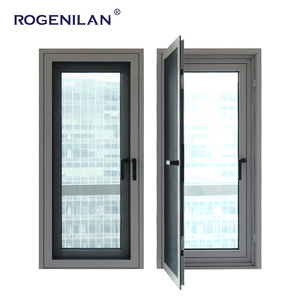
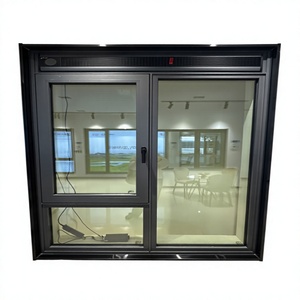
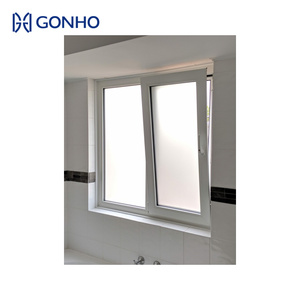
The global architectural facade landscape is undergoing a structural transformation. Commercial developers, building owners, and fenestration contractors across North America and Europe are increasingly bypassing traditional localized distribution channels to partner directly with leading China tilt windows factories & suppliers. This strategic sourcing shift is driven by three key factors: advanced multi-chamber thermal engineering, cost-efficient precision manufacturing, and complete architectural customization.
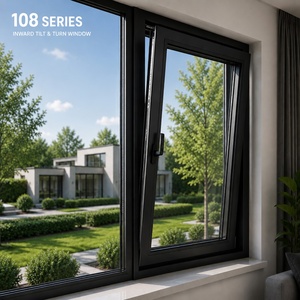
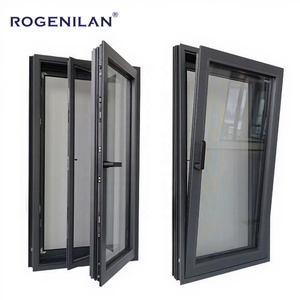
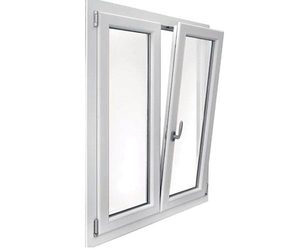
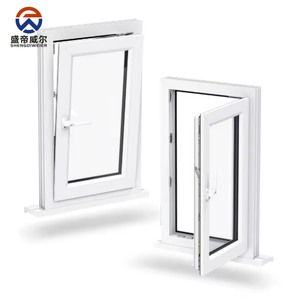
Unlike legacy single-hung or sliding fenestration, the European-style Tilt and Turn Window system represents a sophisticated dual-action mechanism. When operated in the "Tilt" position, the top sash tilts inward at an angle of 10 to 15 degrees, providing secure, draft-free micro-ventilation and natural convection airflow while preventing rain ingress. When rotated into the "Turn" position, the window swings inward 180 degrees on vertical side hinges, enabling effortless interior glass cleaning, emergency egress compliance, and maximum unobstructed ventilation area.
A deep dive into thermal barrier geometry, multi-seal weatherproofing, and multi-point hardware integration.
The baseline structural integrity of high-rise aluminum tilt windows relies on thermal isolation. Leading Chinese manufacturers utilize precision-extruded 6063-T5/T6 architectural aluminum profiles joined by high-grade Polyamide (PA66 GF25) thermal break strips. Reinforced with 25% structural glass fiber, these polyamide barriers prevent conductive heat transfer between exterior and interior profile faces. Advanced 54mm and 34mm insulation cavity systems achieve overall window U-factors down to 0.12 Btu/h·ft²·°F (0.68 W/m²K), meeting rigorous Passive House Institute (PHI) specifications.
A critical failure mode in cheap fenestration is perimeter air leakage and water infiltration under high wind pressures. Premier Chinese suppliers overcome this by integrating continuous vulcanized EPDM (Ethylene Propylene Diene Monomer) gasket systems featuring up to 4 perimeter seals. Dual internal co-extruded air chambers combined with corner-welded gasket joints ensure absolute resistance against wind-driven rain penetration under pressures exceeding 700 Pa, satisfying NFRC and CSA A440 testing criteria.
Operational safety, burglar protection, and perimeter compression tightness depend directly on hardware selection. Premium Chinese factories equip tilt-turn windows with heavy-duty concealed hinges rated for sash weights from 130 kg up to 300 kg, supporting triple-pane, laminated hurricane impact glass units. Concealed perimeter gearboxes drive mushroom-head locking cams into heavy stainless steel keepers located along all four sides of the frame, achieving RC2 / RC3 forced-entry security ratings.
A side-by-side engineering comparison to assist B2B buyers in specifying the ideal window system for residential and commercial development.
| Performance Parameter | Thermal Break Aluminum Tilt & Turn | High-Impact UPVC Vinyl Tilt & Turn | Key Selection Driver |
|---|---|---|---|
| Structural Load Capacity | Extreme high-rise wind loads (Up to 6000 Pa) | Moderate to high wind loads (Up to 3000 Pa) | Building height & exposure category |
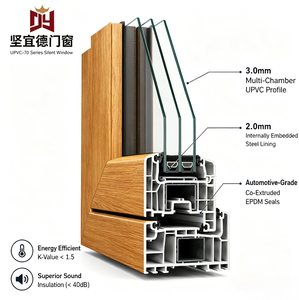
| Thermal Insulation (U-Factor) | 0.14 - 0.22 Btu/h·ft²·°F (Dual PA66 Struts) | 0.11 - 0.18 Btu/h·ft²·°F (Multi-Chamber PVC) | Energy code target (Passive House / Energy Star) |
| Acoustic Isolation (STC) | STC 38 - STC 48 (Laminated Double/Triple) | STC 36 - STC 45 (Acoustic Interlayer Glass) | Urban traffic noise mitigation requirements |
| Frame Sightlines & Aesthetics | Ultra-slim narrow profiles, modern architectural look | Thicker multi-chamber profile sightlines | Architectural vision & daylight opening (VT) |
| Expected Lifespan | 40 - 50+ Years (Fluorocarbon Powder Coating) | 30 - 40 Years (UV-Stabilized Vinyl Resin) | Lifecycle ROI & maintenance costs |
| Fire Safety Rating | Non-combustible (Class A aluminum alloy) | Self-extinguishing (Class B1 PVC compound) | Building code fire spread regulations |
Key technological advancements shaping the next decade of global building envelope supply chains.
As global energy codes enforce net-zero carbon building mandates, the market demand for triple glazed Low-E insulating glass units (IGUs) with Warm-Edge TPS (Thermoplastic Spacer) technology is surging. China's top factories are equipping automated lines with Krypton and Argon gas filling capabilities, bringing overall window assembly U-factors down to passive house standards.
With climate change driving severe storm events, procurement specifications now emphasize hurricane-proof impact tilt turn windows. Modern designs incorporate heavy-gauge aluminum profiles paired with multi-layer SentryGlas (SGP) ionoplast laminated interlayers, tested to withstand missile impact criteria (ASTM E1886 / E1996 and Florida TAS 201/202/203 protocols).
Urban residential towers require high Sound Transmission Class (STC) ratings to isolate occupants from highway and airport noise. Chinese suppliers are innovating with asymmetric glass pane thickness combinations (e.g., 8mm exterior + 16mm acoustic argon gap + 6.76mm PVB interior), achieving sound reduction performance exceeding STC 45 dB.
Integration with Smart Home and Building Management Systems (BMS) is the next frontier. Electric chain actuators concealed inside frame channels allow tilt windows to automatically tilt open for night flush cooling based on CO2 or humidity sensors, closing automatically when rain or high winds are detected.
Derived from 35+ years of vertical integration, extrusion control, and rigorous QA/QC protocols.
In commercial building envelope procurement, project delays and costly on-site failures stem primarily from fragmented supply chains—where extruders, glass fabricators, hardware importers, and field installers operate without unified accountability. Modern enterprise-grade Chinese manufacturers solve this bottleneck by managing a vertically integrated extrusion-to-installation ecosystem.
Direct control over 6063-T5 aluminum billet alloy purity, wall thickness tolerances (AAMA 2604/2605 compliant), and powder coating/PVDF surface finish longevity.
On-site test chambers performing real-time air infiltration (ASTM E283), water penetration (ASTM E331), and structural wind load (ASTM E330) verification before container dispatch.
Dedicated structural engineers providing full BIM Level 2 integration, thermal modeling reports, anchor calculations, and customized shop drawing submittals for architectural sign-off.
Windows are packed in heavy-duty steel-reinforced A-frame crates labeled floor-by-floor and room-by-room to sync perfectly with general contractor crane installation schedules.
Direct answers to the most common questions raised by international buyers, developers, and project engineers.