
Explore our precision-fabricated aluminum fenestration and facade solutions, engineered for maximum Sound Transmission Class (STC) ratings, structural integrity, and thermal compliance in demanding urban environments.
An Architectural Engineering Guide to Sound Transmission Loss, OITC Performance, and Structural Fenestration Integrity for New York Commercial Construction.
Modern metropolitan landscapes present an extraordinarily complex acoustic environment. In high-density global centers like New York City, architectural envelopes must operate as multi-functional barriers: simultaneously providing structural resistance against hurricane-force wind pressure, ensuring thermal insulation to satisfy rigorous energy codes, and delivering acoustic attenuation to insulate building occupants from intense outdoor noise sources. As a premier global acoustic windows exporter supplying high-performance fenestration systems across the United States and international commercial markets, our engineering framework integrates advanced acoustic physics directly into aluminum window manufacturing.
Understanding sound isolation in real-world urban projects requires moving beyond standard window specifications. Sound waves propagate through exterior building envelopes via two distinct mechanical mechanisms: airborne transmission through structural gaps or thin glazing panes, and structure-borne vibration transmitted through rigid window frames. To overcome these acoustic vulnerabilities, specialized fenestration engineering relies on two primary rating metrics established by ASTM international standards:
Evaluated under ASTM E413, STC measures interior sound attenuation primarily against mid-to-high frequency airborne sound frequencies (125 Hz to 4000 Hz), such as human speech, television audio, and high-pitched mechanical noise.
Governed by ASTM E1332, OITC calculates sound attenuation across lower frequency ranges (80 Hz to 4000 Hz), making it the critical metric for measuring low-frequency transportation rumble, diesel engines, subways, and aircraft noise.
By engineering asymmetrical glass pane thicknesses separated by wide, argon-filled air cavities with acoustic PVB interlayers, we eliminate coincidence dip resonance frequencies where sound energy naturally bleeds through.
For high-rise developments, institutional campuses, and multi-family residential towers serving the New York metropolitan region, specifying the correct acoustic window configuration is essential. Under local environmental regulations such as the City Environmental Quality Review (CEQR) E-Designation program, municipal planners frequently mandate window-wall sound attenuation performance ranging from 31 dBA up to 45+ dBA depending on ambient outdoor decibel exposure.
How evolving municipal zoning, energy decarbonization (Local Law 97), and urban noise mitigation codes drive next-generation building envelope design across the Five Boroughs.
In high-density districts surrounding Midtown Manhattan, Financial District, and Hudson Yards, street-level noise regularly exceeds 85 dBA due to heavy bus routes, emergency sirens, and constant vehicular traffic. Architectural developments require window packages that achieve high OITC ratings without sacrificing structural slimness or high light transmittance. Our custom thermally broken window walls incorporate asymmetric laminated glass compositions (e.g., 8mm exterior glass + 0.060" Acoustical PVB + 6mm interior glass) that absorb broad-spectrum vibration while maintaining seamless structural continuity.
Adaptive reuse projects along the Brooklyn Navy Yard, Long Island City waterfront, and Williamsburg frequently convert former manufacturing facilities into luxury residential complexes. These zones face unique acoustic profiles: low-frequency ship horn blasts, elevated subway line rumble (N/W/7 lines), and heavy machinery vibration. By supplying heavy-duty commercial aluminum windows equipped with deep air cavities (up to 20mm warm-edge spacer bars) and multi-point perimeter compression seals, our window exporters deliver STC 42 to STC 48 performance, exceeding NYC Noise Code requirements while ensuring quiet indoor living environments.
Residential, educational, and healthcare facilities located within FAA noise contours around John F. Kennedy International Airport and LaGuardia Airport require extreme low-frequency noise attenuation. Aircraft takeoffs generate sound pressures that easily penetrate standard commercial storefront framing. Our specialized triple-glazed sound barrier window systems integrate SentryGlas® structural interlayers combined with acoustic damping foam inserts inside the extruded aluminum framing chambers, successfully reducing interior sound levels by over 40 dBA.
New York’s ambitious Climate Mobilization Act (Local Law 97) imposes strict carbon emission limits on buildings larger than 25,000 square feet. Historically, adding heavy acoustic glass compromised thermal U-factors. Our latest architectural window profiles feature polyamide thermal breaks, multi-cavity insulation strips, and Low-E soft coatings. This hybrid engineering delivers an extraordinary dual-benefit: lowering building U-factors to under 0.18 BTU/h·ft²·°F while maintaining elite STC 45 acoustic isolation.
Engineering parameters for specifiers, architectural consultants, and general contractors selecting export-grade aluminum window and facade systems for New York project submittals.
| System Classification | STC Rating | OITC Rating | Thermal U-Factor | Water Penetration | Primary NYC Application |
|---|---|---|---|---|---|
| Commercial Thermally Broken Window Wall | STC 38 – 42 | OITC 32 – 35 | 0.22 – 0.26 | 12.00 PSF (580 Pa) | Mid-rise & High-rise Residential Condos |
| Heavy-Duty Acoustic Architectural Casement | STC 43 – 48 | OITC 36 – 40 | 0.18 – 0.22 | 15.00 PSF (720 Pa) | Hospitality, Healthcare & Luxury Suites |
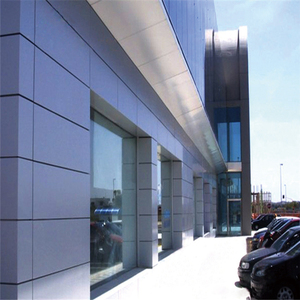
| Pressure-Plate Structural Curtain Wall | STC 40 – 45 | OITC 34 – 38 | 0.20 – 0.24 | 15.00 PSF (720 Pa) | Commercial Towers, Atriums & Lobbies |
| Retrofit Acoustic Secondary Window System | STC 45 – 50+ | OITC 38 – 44 | 0.24 – 0.28 | 10.00 PSF (480 Pa) | Pre-War Historical Conversions & Hotels |
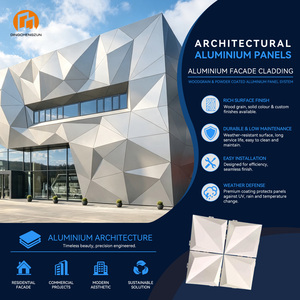
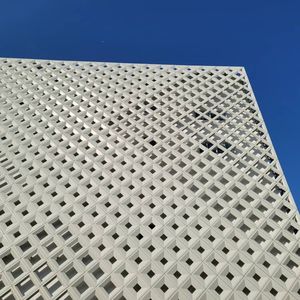
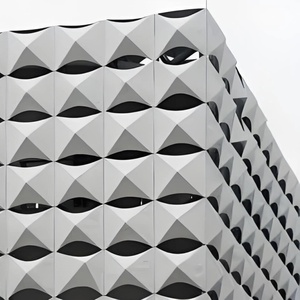
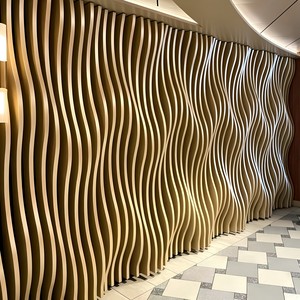
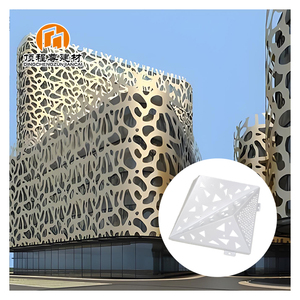
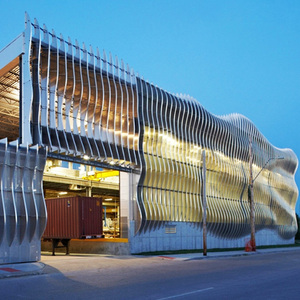
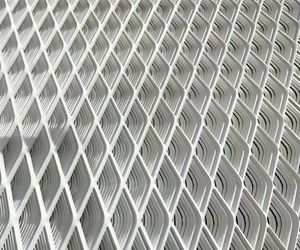
| Perforated Metallic Kinetic Facade Cladding | Acoustic Baffle | Wind Break | Shading Factor | Rainscreen Barrier | Exterior Acoustic Shielding & Solar Shading |
Single-source vertical integration from raw aluminum extrusion to precision manufacturing, acoustic lab testing, and international project delivery.
We manage the complete manufacturing lifecycle under one roof. Our facility extrudes high-tensile 6063-T6 architectural aluminum alloy profiles, ensuring exact dimensional tolerances, uniform wall thicknesses, and superior structural rigidity needed for high-rise wind loads.
Every window series is subjected to rigorous physical laboratory testing in accordance with AAMA/WDMA/CSA 101/I.S.2/A440 (NAFS) protocols. We provide fully documented test reports detailing STC, OITC, air infiltration rates, and structural water resistance for immediate architect sign-off.
Deploying fenestration packages into congested job sites in New York demands exceptional logistics planning. We custom-crate window units by floor breakdown, orientation elevation, and installation phase—enabling seamless, floor-by-floor offloading with minimal storage overhead.
Answers to key technical, regulatory, and logistics questions raised by developers, architects, and acoustic engineers evaluating imported fenestration packages.
The NYC City Environmental Quality Review (CEQR) program places E-Designations on properties requiring specified outdoor-to-indoor sound attenuation (typically 31, 35, 38, or 41+ dBA reduction). Our engineering team designs custom glass make-ups combining heavy asymmetric float glass, high-density acoustic PVB interlayers, and warm-edge spacer bars. We provide certified laboratory test reports (ASTM E90 / ASTM E413) demonstrating full compliance with CEQR window-wall attenuation targets.
Yes. We specialize in both new construction and occupied-building retrofits. For historic or occupied residential towers across Manhattan and Brooklyn, we export custom trim sub-frames and panning systems that allow rapid suite-by-suite window replacement. Our designs maintain historic exterior sightlines while upgrading the interior acoustic attenuation from an outdated STC 25 up to a high-performance STC 45+.
High-rise coastal developments in New York must withstand severe structural wind pressures. Our heavy-duty aluminum curtain walls and window wall systems are structural-engineer validated for wind loads exceeding 75 to 100+ PSF (pounds per square foot), meeting American Architectural Manufacturers Association (AAMA) AW (Architectural Window) rating requirements without compromising acoustic damping capabilities.
When two panes of glass in an insulated glass unit (IGU) have identical thicknesses, they vibrate at the same coincidence frequency, creating a "dip" in sound isolation performance. By specifying asymmetric glass thicknesses (for example, a 1/4" [6mm] exterior pane combined with a 3/8" [10mm] laminated interior pane), the two panes target different frequency bands, effectively flattening the resonance coincidence dip and boosting overall STC and OITC ratings by 4 to 8 decibels.
Upon final shop drawing approval and sample verification, standard production and export lead times typically range from 6 to 10 weeks. Products are shipped in heavy-duty ocean freight containers directly to the Port of New York and New Jersey. Deliveries are scheduled floor-by-floor to align precisely with your site erection plan, avoiding jobsite storage bottlenecks.
Consult with our senior fenestration specialists today. Submit your architectural elevations, acoustic specifications, or tender documents for a comprehensive acoustic analysis and competitive export quotation.